What Ingredient List Order Tells You About Packaged Food
Ingredient list order helps you compare what packaged foods are mainly made from, while showing which details to check before choosing one for your needs.
The common mistake with ingredient list order is treating the first item as a verdict: a long list must mean poor quality, or a familiar ingredient makes a product the right choice. That shortcut can leave you overlooking composition, dietary needs or how the food will work in your meal.
In many places, ingredients are listed from greatest to least by weight, but labelling rules and exceptions can vary. Read the product’s full label and check local guidance if a particular wording matters to your decision. The order is a clue to composition, not a ranking of healthfulness, taste or suitability.
What does ingredient list order tell you?
Start with the first few entries and ask what they suggest about the recipe. In tomato sauce, tomatoes near the top suggest they contribute more by weight than ingredients listed after them. The list does not give exact amounts, so it cannot tell you how much of each ingredient the product contains.
Order is most useful when comparing similar foods. If you are choosing between two breakfast cereals, note whether oats, another grain, fruit or a sweetening ingredient appears first. Then check the rest of the label for the details that matter to you. A leading ingredient is not, by itself, a quality score.
How can you use the order for a specific choice?
Match your reading to the question you need answered. For taste or cooking, the leading ingredients can suggest whether a sauce may be tomato-forward or whether a seasoning blend may be salt-forward. For nutrient details, consult the nutrition panel; for an ingredient you need to avoid, read the entire list and relevant allergen information.
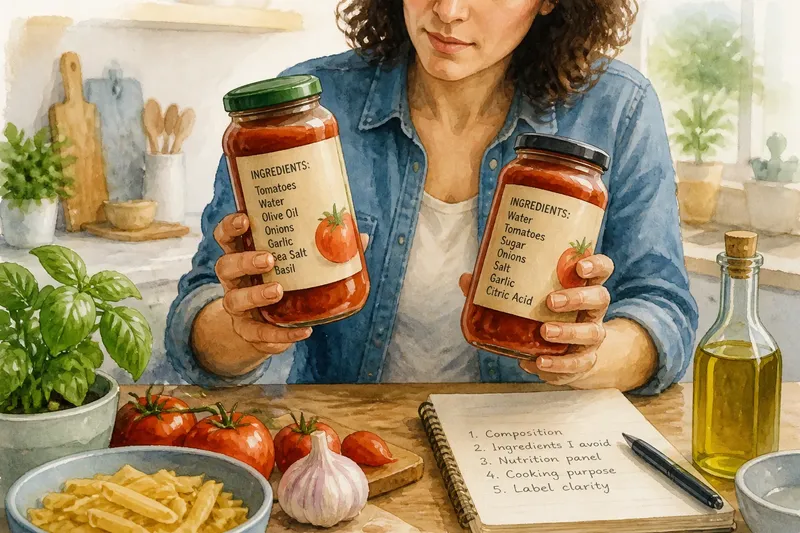
Say you are choosing between two jars of tomato sauce for pasta. Jar A lists tomatoes, water and olive oil first; Jar B lists water, tomatoes and sugar first. You note that the lists suggest different broad compositions, then check the nutrition panels and scan both full lists for anything you avoid. If Jar A better fits your preference and neither label raises a concern, you choose it; if the nutrition details or another ingredient change the picture, you reconsider. The result is a choice based on your priorities, not proof that one sauce is best for everyone.
- Product match: Check that both items serve a similar purpose; if they do, compare their lists, but if not, choose a more like-for-like pair.
- Leading ingredients: Check the first few entries; if they fit the composition you want, continue considering the product, but if they do not, compare another option.
- Ingredient you avoid: Check the whole list and allergen information; if you find a relevant ingredient, set the product aside, but if the wording is unclear, check applicable guidance or ask the manufacturer.
- Nutrient concern: Check the nutrition panel; if its details fit your needs, keep the product in consideration, but if they do not, compare another product.
- Cooking purpose: Check whether the listed ingredients suit the dish; if they do, use the product for that purpose, but if not, select one better suited to the recipe.
- Unclear label wording: Check the package information and applicable local guidance; if the answer remains uncertain, contact the manufacturer, but if the detail does not affect your choice, move on.
What is not worth the effort is trying to infer an exact recipe from list position or decoding every minor ingredient when it has no bearing on your choice. The order gives relative placement, not a precise breakdown.
What can’t ingredient list order tell you?
Order cannot establish whether a food is nutritious overall, whether you will enjoy it or whether it suits a particular person. A short list is not automatically better than a long one, and a late-listed ingredient may still matter if you avoid it. Use the nutrition panel for nutrient information and your own preferences for taste, convenience and cooking needs.
For an allergy or medically necessary restriction, do not rely on ingredient position to decide that a product is safe. Read the full ingredient and allergen information, and seek advice from a qualified health professional if you need help interpreting it. Labelling details can vary by product and location.
Which questions about ingredient list order come up most?
Does the first ingredient make up most of the product?
Where the applicable rules list ingredients by weight, the first is used in a greater amount than the ingredients after it. That does not necessarily mean it makes up more than half the product.
Does a shorter ingredient list mean better food?
No. List length alone does not tell you about nutrition, quality or whether the food fits your needs. Compare the details that matter for your choice instead.
Can ingredient order tell me how sweet a product tastes?
It can show where sweetening ingredients appear relative to others, but it cannot reliably predict the finished taste. Check the nutrition panel too if sugar is part of your decision.
Can I ignore an ingredient near the end?
No, not if it matters to your preferences, ethics or health. Read the whole list and relevant allergen information, since a lower position does not make an ingredient irrelevant.
How should you make the final comparison?
Use ingredient list order to answer a focused question: what appears to contribute most, or which similar product seems closer to your intended use? Then check the full list, nutrition information and any relevant allergen details. Ingredient list order is useful as one part of a decision, not as a verdict on the food.
When comparing packaged foods, keep the question concrete and stop once you have the information you need. That makes the label easier to use and helps you choose for the meal and the person eating it.