A Pantry Map That Makes Opened Packages Easier to Find
A pantry map for opened packages keeps foods in clear, useful places, so you can spot what is already open and make meal choices with less rummaging.
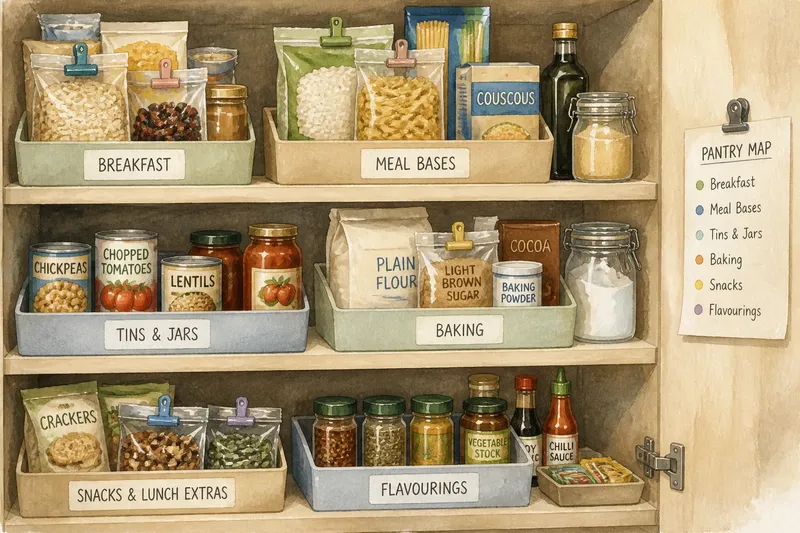
The common pantry mistake is putting an opened packet back wherever it fits. It can disappear behind new purchases, leaving you to rummage when you are choosing a meal. A pantry map for opened packages gives each food a clear home and helps you see what is already available.
The map need not be a drawing or an inventory. It can be a simple arrangement you remember: a few groups that suit your cooking, with opened foods easy to spot. The aim is a cupboard you can read at a glance, not a row of matching jars.
What should a pantry map for opened packages include?
Start with broad groups that match how you reach for food. You might use “breakfast”, “meal bases”, “tins and jars”, “baking”, “snacks” and “flavourings”. If rice, noodles and couscous are the sides you use most, one “meal bases” section may be easier than separate categories for every grain.
Give each group a physical home: a shelf, part of a shelf or an open-sided bin. Put foods where you would naturally search for them. Keep an opened pack visible at the front or on top, with an unopened spare beside it or behind it. That makes the current packet easier to pick up without creating a separate tracking system.
- Meal bases: rice, pasta, noodles and couscous.
- Tins and jars: beans, lentils, tomatoes and sauces.
- Breakfast: oats, cereal, dried fruit and spreads.
- Baking: flour, sugar, raising agents and ingredients used together.
- Snacks and lunch extras: crackers, nuts and seeds.
- Flavourings: spices, stock, sauces and condiments.
These are options, not rules. Place an ingredient where you are most likely to look for it. If a food regularly belongs with several meals, choose its main home and use a small tray for related packets only if that makes them easier to find.
How do you make a pantry map for your cupboard?
Use the cupboard you have. Keep frequent ingredients within easy reach, and leave room to return packets without shifting everything else. A note inside a cupboard door can help if household members often search in different places, but the arrangement itself may be enough.
- Notice your search habits. Think of foods you reach for often, such as oats at breakfast or pasta for supper. If you repeatedly search for a food in the same place, give it a home there; otherwise, group it with ingredients you use alongside it.
- Choose a few plain-language groups. Names such as “breakfast” and “quick meals” are easy to remember. If two groups keep overlapping, combine them; if one becomes hard to scan, split it.
- Assign each group a shelf or section. Leave a clear space for its usual packets. If a group will not fit without hiding food, use a separate bin or choose a less crowded home.
- Put opened packets where they are visible. Fold and clip a suitable bag, then place it in front of or beside unopened stock. If the packet still slips or spills, use a suitable container and retain relevant product information.
- Add only aids that solve a problem. Use a shallow tray for loose sachets or a label for a confusing group. If an aid makes food harder to identify or reach, remove it.
- Check the arrangement during an ordinary pantry glance. If you keep searching in the wrong place, move the food or rename the group; if the location works, leave it alone.
Say you find an opened bag of rice behind cereal while planning dinner, and the spare rice pack is in the same crowded cupboard. Move both to a “meal bases” section, put the opened bag at the front and set the spare behind it. The result should be visible: the next time you look there, the packet already in use is easiest to pick up, and you can see that another pack is available without confusing the two.
What should you check before settling on a layout?
- If opened packets are hidden behind unopened ones, move the open packets to the front; if the shelf is too crowded, assign the group a less crowded section.
- If small sachets slide to the back, gather them in a shallow tray; if the tray blocks larger foods, remove it and give the sachets a clear shelf space instead.
- If a packet will not stay closed, use a suitable clip or container; if transferring it would make the contents or product information unclear, keep the original packaging and store it in a tray.
- If a food is hard to identify in its new place, return it to its original packaging or add a clear label; if the label still leaves relevant information out of view, keep the package details accessible.
- If you have to move several items to reach a frequently used food, bring that group within easy reach; if it is used only occasionally, keep it further back while ensuring it remains identifiable and retrievable.
- If you spot a spill, damaged packaging or signs of pests, deal with the concern before rearranging the shelf; if you are unsure whether food is safe, follow label guidance and seek qualified food-safety advice.
For storage conditions and advice about food after opening, follow the product label and manufacturer guidance. A tidy arrangement helps you find ingredients, but it cannot establish whether food is safe by appearance alone.
What can a visible pantry change about meal choices?
When opened ingredients are easy to see beside foods commonly used with them, you can notice possible combinations as you decide what to cook. A tin of beans beside pasta and an opened jar of sauce may suggest a quick supper, without requiring a full weekly plan.
A pantry map can also make a routine check simpler: scan the front of each group, notice anything repeatedly overlooked, and decide whether it needs a clearer home. There is no need to pull every packet out if the arrangement already lets you see what is there.
What do people ask about pantry maps?
Do I need to label every shelf?
No. Label groups that are easy to confuse or that other household members struggle to find. If the arrangement is already clear, extra labels may only add clutter.
Can opened and unopened food share a group?
Yes. Keep the opened packet at the front or beside the spare so it remains visible and easy to choose first. If the spare keeps covering it, change their positions or give them more space.
What if a food fits in more than one group?
Choose the place where you most often look for it and keep that choice consistent. If several small ingredients are used together, a shared tray can help, provided the food stays identifiable.
When should I change the pantry map?
Change it when your cooking habits or cupboard contents shift, or when you repeatedly search in the wrong place. If the current arrangement is easy to use, there is no need to revise it on a schedule.
What is not worth the effort?
A detailed inventory, colour-coordinated shelves and matching containers for every ingredient rarely solve the basic problem of an opened packet disappearing from view. Decant only when it addresses a real issue, such as a bag that will not close; otherwise, the original package can keep its contents and useful information together.
The most useful pantry map for opened packages is the one that works on an ordinary evening: a few familiar groups, a visible place for the packet already in use, and enough space to return everything without rearranging the cupboard.